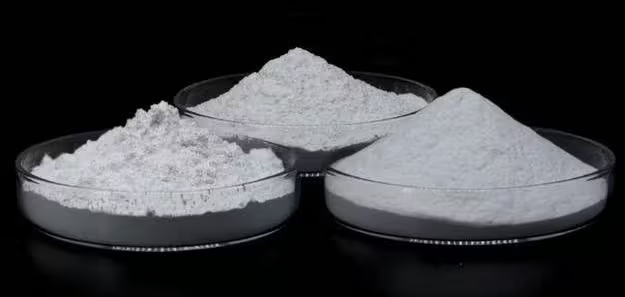
Specialty powders play an important role in many manufacturing processes. Coatings, polymers, adhesives, ceramics, and composite materials may all require carefully selected inorganic fillers with predictable physical characteristics.
When sourcing fine aluminum oxide, manufacturers need to consider more than availability. Product specifications, batch consistency, surface characteristics, technical support, packaging, and logistics can all affect the success of a supply relationship.
Read Also: Building a Flexible Manufacturing System for Bent Glass
Define the Required Specification
The sourcing process should begin with a clear specification.
Depending on the application, this may include:
- Chemical purity
- Particle size
- Specific surface area
- Surface treatment
- Bulk density
- Moisture content
- Dispersion characteristics
- Packaging size
Having these details available helps purchasing and technical teams evaluate potential suppliers consistently.
Understand the Intended Function
Fine alumina can serve different functions depending on the formulation.
It may act as a filler, reinforcing component, rheology modifier, thermal material, or ceramic-processing ingredient.
The required characteristics will change according to its intended role.
A product selected for a polymer composite may have different requirements from one used in a coating.
Evaluate Particle Distribution
Average particle size alone may not provide enough information.
Particle-size distribution can influence packing, surface area, and dispersion.
Manufacturers should determine whether the supplier provides appropriate particle data and whether the reported measurement method is consistent.
This is particularly important when comparing materials from different sources.
Examine Surface Properties
Surface chemistry can influence interaction with other components.
For example, untreated alumina may behave differently from a surface-modified grade when added to a polymer or adhesive.
The supplier should provide information about available surface treatments and their intended applications.
Test Dispersion Behavior
Fine powders can form agglomerates.
A supplier’s product specification may look suitable while still behaving differently in a customer’s formulation.
Application-specific dispersion testing can therefore be valuable.
The laboratory should evaluate the actual production solvent, resin, binder, or polymer rather than testing the powder in isolation.
Check Batch Consistency
Repeated production requires predictable raw materials.
Manufacturers should evaluate whether the supplier maintains consistent particle characteristics, purity, moisture levels, and other important specifications.
Long-term records can help identify whether material properties remain stable across different production batches.
Packaging and Storage
Fine powders must be protected from contamination and excessive moisture.
Packaging should be appropriate for transportation, warehouse storage, and production handling.
Manufacturers should also follow recommended storage conditions and use suitable inventory procedures.
Technical Documentation
Good technical documentation helps both purchasing and engineering teams.
Useful documents may include technical data sheets, certificates of analysis, safety information, product specifications, and storage recommendations.
Clear documentation can also simplify internal approval procedures.
Technical Support
Technical assistance can be useful when a manufacturer encounters dispersion, compatibility, or processing issues.
A supplier with application knowledge may help identify whether the problem relates to particle characteristics, formulation chemistry, or processing conditions.
This can shorten development cycles.
Supply Reliability
Commercial sourcing also requires attention to logistics.
Lead time, production capacity, minimum order quantities, transportation options, and inventory availability should be reviewed before establishing a long-term supply arrangement.
Reliable delivery helps manufacturers maintain production schedules.
Comparing Potential Suppliers
When comparing a fumed al2o3 supplier companies should consider the complete package of technical and commercial factors.
A simple price comparison may overlook differences in purity, consistency, packaging, technical service, or usable material yield.
A structured supplier scorecard can make comparisons easier while keeping technical requirements clear.
Pilot Production
After laboratory testing, a pilot production run can provide additional information.
The material should be processed using conditions that closely resemble normal manufacturing.
Engineers can then compare mixing time, viscosity, dispersion, product appearance, mechanical properties, or other application-specific measurements.
Frequently Asked Questions
1. What should be included in an alumina purchasing specification?
It may include purity, particle size, surface area, surface treatment, moisture content, packaging, and other properties relevant to the application.
2. Why is batch consistency important?
Changes in raw-material characteristics can affect processing conditions and final product performance.
3. Should suppliers provide technical documents?
Yes. Technical data and quality documentation help manufacturers verify material specifications and manage production requirements.
Conclusion
Sourcing fine aluminum oxide requires coordination between technical, quality, purchasing, and production teams. Clear specifications, laboratory testing, supplier evaluation, and supply planning can help manufacturers establish a dependable raw-material source.
By evaluating the full technical and commercial picture, companies can make better-informed sourcing decisions and reduce avoidable production variability.