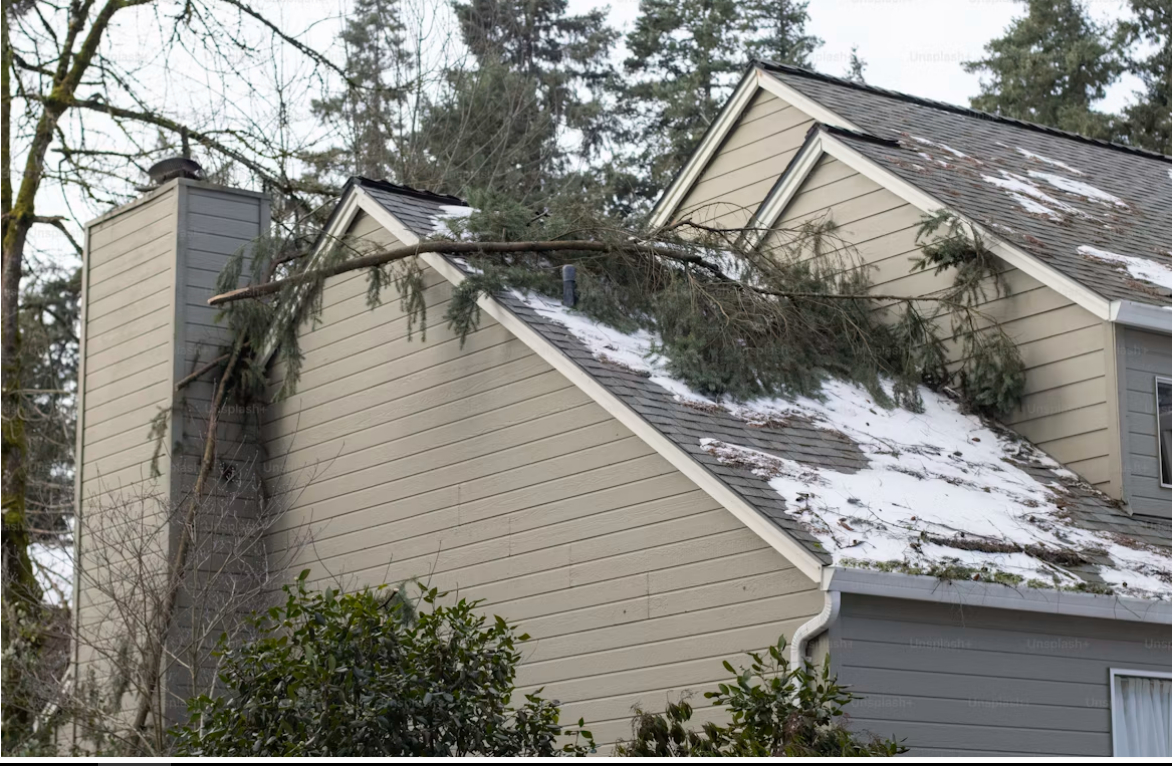
A tree branch through the roof is one of the more dramatic emergency calls a roofing contractor handles. The damage isn’t subtle. There’s an actual hole in the structure. Sometimes a whole limb sits inside the attic. Water poured in through the breach during whatever storm caused it. Drywall is failing on the floor below as ceiling cavities fill. Insulation soaking through. The interior of the house becomes a wet space within hours. Most of this damage is preventable, but the prevention work happens months or years before the storm event, through tree management around the property that most homeowners don’t think about until after a limb has come down.
The other piece worth understanding is that tree branch penetration mostly isn’t random. Specific trees and specific limbs fail in storms in patterns that experienced arborists and roofing professionals recognize easily. Dead branches. Codominant stems with included bark. Trees that have grown taller than the surrounding canopy catch wind unevenly. Root issues that compromise the whole tree’s stability. The tree that ended up on the house usually showed signs of being the one that would. So, an emergency roofing service call in Towson after a storm is often the result of a tree assessment that wasn’t done during calmer weather.
Towson homeowners have several contractors to call after storm-related roof damage. Magnum Home Services, LLC is one of the Towson-area emergency roofing service providers, handling tree-strike repairs alongside other storm restoration work. Nothing here recommends any specific contractor. It’s a practical walkthrough of how tree-related roof damage actually happens, what prevention looks like at the homeowner level, and what to do when prevention runs out of time.
Tree Branch Penetration
The Maryland storm pattern produces several events each year that can cause branches or whole trees to fall onto houses. Summer thunderstorms with microbursts and straight-line winds. Nor’easters with sustained high winds across multiple days. Ice storms that load branches with weight they can’t handle. Occasional remnants of tropical systems push inland from the Atlantic.
Each of these events finds the weakest trees first. Healthy trees with good structure usually ride out moderate weather. Trees with structural problems, dead limbs, or compromised root systems are the ones that fail when conditions push them past their margin. Tree branch penetration of a roof almost always traces back to a tree that was telling the homeowner something needed attention, except the homeowner either didn’t notice or didn’t act on what they did notice.
See also: What a Professional House Cleaning San Diego Package Includes
How Trees Fall on Houses
Failure modes for trees near houses fall into a few patterns. A whole tree comes down at the root plate, usually after saturated soil reduces root anchoring during heavy rain followed by wind. A large branch tears off the main trunk, often where the branch joined the trunk through a poorly attached junction. A leader fails on a multi-trunked tree where the trunks grew together with bark trapped between them (including bark). A dead branch that had been hanging for months finally gives up in moderate wind.
Each of these patterns is identifiable in advance by someone who knows what to look for. The International Society of Arboriculture’s guidance on pruning your trees covers a structural pruning approach that addresses these failure modes before storm events occur. Regular structural pruning over a tree’s lifetime produces a tree that holds together under stress. Skipping pruning over decades produces a tree that doesn’t.
Identifying the Hazard Trees Around the Property
A walking inspection of trees within striking distance of the house surfaces most of the hazards. Look up. Visible dead branches in the canopy. Branches angling toward the house are at obvious risk. Trees are leaning notably toward the house. Trees with multiple trunks where the trunks meet at sharp angles, sometimes with bark visible in the seam.
Look down. Mushrooms or fungal growth at the base of the trunk (often a sign of root rot). Cracks in the soil radiating out from the trunk (a sign the root plate is moving). Heaving soil on the opposite side of a leaning tree. Hollow sounds when the trunk is tapped.
These warning signs don’t always mean immediate removal is necessary. They mean that a professional assessment is appropriate. A certified arborist can tell the difference between a tree showing early signs of stress that can be managed and one that’s actually a hazard requiring removal.
Distance From House and Pruning Considerations
The general rule is that any tree within the house’s height is a potential striker if it fails. A 60-foot oak within 60 feet of the house can reach the house when it comes down. This doesn’t mean every tall tree near a house needs to be removed. It means trees in that zone need active management.
The Insurance Institute for Business & Home Safety’s thunderstorm preparation guidance specifically recommends trimming trees with branches overhanging the roof or near windows as a key step in reducing damage from high winds. Overhanging branches are the easiest target for proactive pruning. Removing them eliminates the most direct path from the tree to the roof in the event of a branch failure. The structural pruning that should happen alongside that is for the rest of the canopy, addressing weight distribution and weak attachments before they become storm losses.
Annual Inspection Routine
A reasonable routine for any property with mature trees in striking distance of the house. Walking visual inspection twice a year, ideally late winter (when deciduous canopies are bare and structural issues are easier to see) and late summer (when leaf weight is at maximum and any stressed trees are showing signs). Professional arborist assessment every two to five years, depending on the trees involved and any concerns the walking inspection surfaced.
This routine catches most hazards before they become emergencies. It also produces a documented history that supports insurance claims if something fails despite the preventive work. The cost of regular tree care over the years is significantly less than the cost of a single tree-strike repair. Maintenance pays for itself in the damage it avoids.